Iptv Sports Channels
04.10.2026
IPTV for the Tax Litigation World: How Boston Tax Professionals and Their Clients Stream Live Football Without Cable
Tax season in Boston is a marathon. Between IRS notices, appeals deadlines, installment agreements, and the endless paperwork that comes with representing taxpayers before the IRS, downtime is precious. And for most tax professionals — and the clients they serve — downtime means one thing: watching the game. Whether it is the Patriots on a Sunday, a Celtics playoff run, or a Brasileirão match on a Saturday afternoon in Framingham, live sports is how this city decompresses.
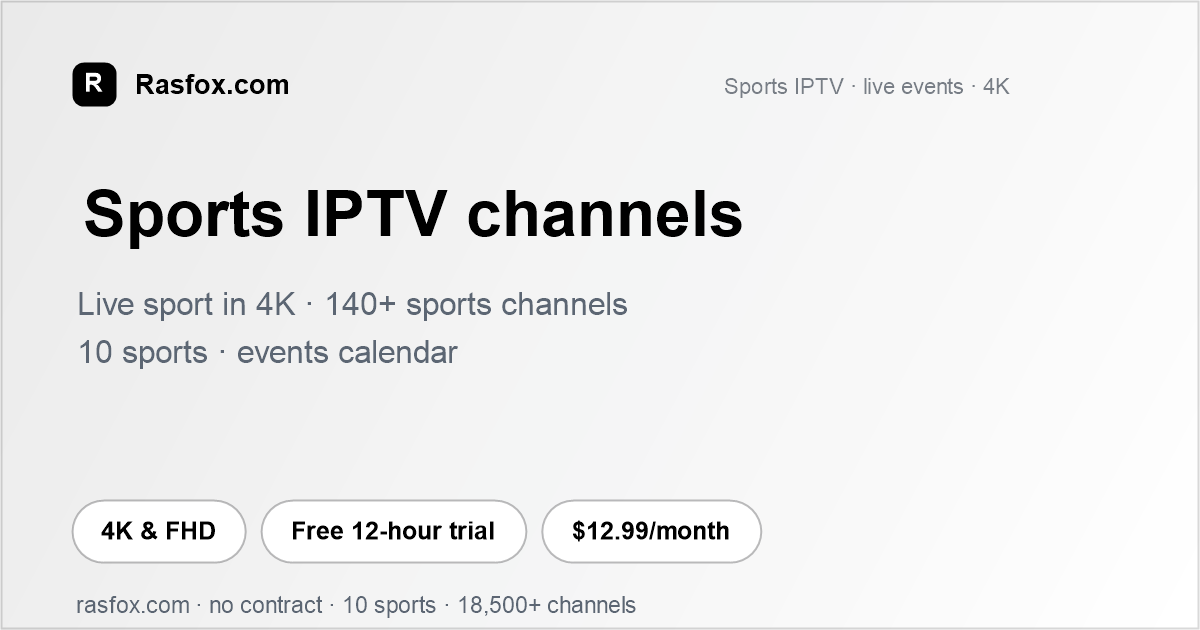
That is exactly where IPTV enters the picture. Internet Protocol Television is quietly replacing cable boxes in Boston apartments, suburban homes, and even the waiting rooms of accounting firms. And when it comes to sports — real sports, live sports, in 4K — one name keeps coming up in conversations with lusophone and Latino families across Massachusetts: RasFox. This article explores the tax world through a slightly different lens: how IPTV fits into the lives of tax litigators, enrolled agents, CPAs, and the clients they fight for every April.
What Is IPTV and How Does It Change the Way You Watch Live TV and Football?
IPTV stands for Internet Protocol Television. Instead of pulling signals from a coaxial cable or a satellite dish, IPTV delivers channels over your existing internet connection — the same fiber or cable line that already brings you email, Zoom calls, and client portals.
The practical difference is enormous:
- No installation appointments. No technician, no drilling, no waiting windows. If you have Wi-Fi, you have TV.
- No geographic limits. A tax attorney in Back Bay can watch the same broadcast as a colleague in São Paulo or Buenos Aires.
- No fixed contract. Cable bundles lock you in for 12 or 24 months. IPTV subscriptions can be monthly — useful when your cash flow follows a seasonal tax cycle.
- Better picture quality when done right. Premium providers stream at 4K and 50FPS, which is smoother than most traditional broadcasts for fast-moving sports like football and Formula 1.
For a profession that bills by the hour, the time savings alone matter. Setting up IPTV takes minutes, not days — and it can run on a smart TV, a Fire Stick, an Android box, a laptop, or even a phone between client meetings.
The Thematic Bridge: Why Tax Professionals and Taxpayers Get More From IPTV
Here is the overlap nobody talks about. Tax litigation is a discipline of cost control and contracts. You spend your days reviewing agreements, negotiating penalties, and finding legitimate ways to reduce what your clients owe. Streaming television works on the exact same principles.
A traditional cable package in Massachusetts often runs $90 to $150 per month after promotional pricing expires, and it typically comes with a multi-year commitment, equipment rental fees, and a bundle you never asked for. For a small tax firm with three employees and a waiting-room TV, that is thousands of dollars a year on a non-deductible-adjacent luxury. IPTV flips that math.
Key takeaway: If you advise clients to eliminate unnecessary recurring expenses, it makes sense to apply the same logic to your own household or office budget. An IPTV subscription with a trusted IPTV provider can replace a cable bill at a fraction of the price, with no long-term obligation — the same flexibility a taxpayer wants when negotiating a payment plan with the IRS.
There is a second, softer bridge. Tax litigation is stressful work. Deadlines, penalties, and adversarial correspondence take a toll. Having reliable access to live sports — a football match, a UFC card, a Formula 1 race — is genuine stress relief. You cannot pour from an empty cup, and you cannot defend a client before the U.S. Tax Court if you never step away from the desk.
Inside the Boston and U.S. IPTV Landscape
Boston is one of the most internationally connected cities in America, and nowhere is that clearer than in the streaming habits of its residents. Massachusetts is home to one of the largest Brazilian communities in the United States, alongside significant communities from Portugal, Cape Verde, the Dominican Republic, Colombia, Venezuela, and Argentina. Framingham, Somerville, Allston, and East Boston each have their own streaming cultures.
That diversity creates a specific problem. A taxpayer who moved from Minas Gerais wants Globo and SporTV. A family from Buenos Aires wants TyC Sports. A lifelong Bostonian wants ESPN, NESN, and the NFL. A single cable package rarely satisfies all three — and international channel add-ons are expensive or simply unavailable.
A Sports-First Platform Built for Diaspora Communities
This is where RasFox distinguishes itself. The platform is built with a total focus on sports channels and live sports events — not filler. Its roots trace directly to Radio Malena 89.1 FM in Buenos Aires (Venezuela 370), a station long associated with tango and Argentine cultural tradition. That broadcasting heritage evolved into an IPTV service designed specifically for lusophone and Latino audiences worldwide, with Portuguese and Spanish support available 24 hours a day.
Depending on where your clients and staff come from, the channel lineup typically includes:
- Brazil: Globo, SporTV, Premiere, ESPN Brasil, BandSports, Combate, TNT Sports BR
- Portugal: Sport TV 1–6, Eleven Sports, Benfica TV, Porto Canal, DAZN Portugal, Eurosport
- Latino America: TyC Sports, ESPN Premium, TNT Sports Argentina, Fox Sports, DirecTV Sports
- Africa: SuperSport, Sport TV Africa, ESPN Africa
- Worldwide: ESPN, DAZN, Fox Sports, beIN Sports, Sky Sports, Eurosport
And the competitions? Brasileirão, Libertadores, the Champions League, Liga Portugal, Liga Argentina, La Liga, the Premier League, Formula 1, UFC, the NFL, NBA, and MLB. For a tax firm whose clients come from every corner of the world, that breadth is not a luxury — it is a service differentiator. Imagine a waiting room where a client from Salvador can watch the Bahia match while their documentation is prepared.
The scale matters too: over 12,000 channels and 40,000 on-demand titles in 4K at 50FPS. That is not a side-loaded playlist; it is a structured library.
Hardware and Setup: A Simple Guide for Busy Professionals
The beauty of IPTV is how little equipment it requires. If you can set up a client portal login, you can set up IPTV in under fifteen minutes.
Minimum Requirements
- Internet speed: 10 Mbps for HD, 25 Mbps or higher for 4K streams
- Device: Amazon Fire TV Stick, Android TV box, Smart TV (Samsung, LG, Android TV), Apple TV, iOS, Android, or a computer with VLC
- Router: Wired Ethernet is ideal for office setups; 5 GHz Wi-Fi works well for most homes
Steps to Get Started
- Choose a provider with a 24-hour IPTV free trial so you can test buffering performance before paying.
- Install the recommended player app on your device.
- Enter your credentials, then browse the sports categories first.
- Test during peak hours — that is when a weak provider reveals itself.
- If your office has multiple viewing areas, confirm the plan supports multiple simultaneous screens. RasFox supports 2 screens per subscription, which covers most small firms.
For anyone comparing the market, this guide to the best IPTV service for live football is a useful starting point, particularly if the priority is smooth playback rather than sheer channel count.
Legal vs. Illegal IPTV: Staying Compliant While You Watch the Game
This is the section tax professionals will appreciate most, because it mirrors the work you already do: distinguishing legitimate structures from risky ones.
Legal IPTV services operate with proper licensing and distribution agreements. They publish clear terms of service, process payments through standard gateways, provide responsive customer support, and do not ask you to install unusual software or download suspicious APK files from forum links.
Illegal IPTV operations typically:
- Sell "lifetime" access for a one-time payment of a few dollars
- Accept only crypto or unverifiable payment methods
- Offer no support, no terms, and no company information
- Repackage premium channels with no plausible licensing path
Beyond the ethical issue, there is a practical one. Unlicensed streams get shut down constantly. The channels disappear mid-match, the service vanishes, and the "lifetime" subscription lasts three weeks. If you are running a business waiting room or a home setup you actually depend on, that instability is unacceptable.
Best practice: work with a provider that is transparent about what it offers, offers a trial so you can verify quality, and provides real support in Portuguese, Spanish, or English. RasFox fits that profile — a no-contract subscription, a 24-hour free trial, and genuine PT/ES support, with no long-term commitment required. If the service does not perform, you walk away.
Why a Sports-First Provider Beats a Generic Bundle
Most IPTV providers pad their listings with thousands of channels nobody watches, then hope you never test the ones that matter. A sports-first provider is structured differently: the sports categories load fast, the streams are stable during peak match windows, and the on-demand library includes full match replays.
Here is what that means in practice for a Boston tax professional:
- No buffering during the second half. Stability is engineered for high-demand live events, not just movies.
- 40,000 VOD titles in 4K 50FPS — catch the match you missed while reviewing a client's audit file.
- 2 simultaneous screens — one for the home office, one for the living room.
- No contract. Seasonal flexibility that matches a tax practice's cash flow.
- 24h free trial — test it before committing a dollar.
In a city where the work never really stops between January and April, a dependable stream is a small but real quality-of-life investment.
Conclusion: Save on the Bill, Keep the Game
Tax litigation professionals spend their careers helping people keep more of what they earn and eliminate unnecessary financial obligations. Applying that same discipline to your own entertainment budget is not contradictory — it is consistent. A cable contract with rising rates and expiring promotions is exactly the kind of recurring expense you would flag for a client.
IPTV — specifically a sports-focused service like RasFox — gives you live football, international channels for your family and staff, 4K quality, and no long-term commitment. It is the same principle you preach in every engagement: pay for what you actually use, and never sign something you cannot walk away from.
Ready to test it? Start with the 24-hour free trial, check the sports categories first, and judge it during a live match. If it holds up, you have just cut a bill and gained back your weekends. Explore RasFox IPTV and start your free trial today.
Frequently Asked Questions
Is IPTV legal in the United States?
IPTV technology itself is completely legal. Legality depends on how the provider licenses and distributes content. Services with proper licensing, transparent terms, and standard payment processing operate legally. Unlicensed services that sell premium channels cheaply with no licensing path are the problematic ones.
How much internet speed do I need for live sports in 4K?
For HD streams, 10 Mbps is generally sufficient. For 4K at 50FPS, plan for at least 25 Mbps per stream. If two screens are running simultaneously, 50 Mbps is a comfortable baseline.
Can I watch Brazilian, Portuguese, and Argentine channels from Boston?
Yes. That is one of the main reasons diaspora communities choose IPTV. Sports-focused platforms commonly carry Globo, SporTV, Premiere, Combate, Sport TV, Benfica TV, TyC Sports, ESPN Premium, and DirecTV Sports, alongside standard U.S. sports networks.
Do I need a contract or special equipment?
No contract is required with a flexible IPTV provider — you can subscribe monthly. In terms of equipment, a Fire TV Stick, Android box, or smart TV is enough. No dish, no cable box, and no installation technician.
What happens if the stream starts buffering?
Buffering is usually caused by weak Wi-Fi or an overloaded provider. Switching to a wired Ethernet connection often solves it immediately. If the issue persists across multiple channels during peak hours, it is a provider problem — which is why a free trial before committing is essential.
Is there support in Portuguese or Spanish?
Yes. Providers serving lusophone and Latino communities typically offer 24-hour support in Portuguese and Spanish, which makes troubleshooting and setup far easier for families and business owners who prefer to communicate in their native language.